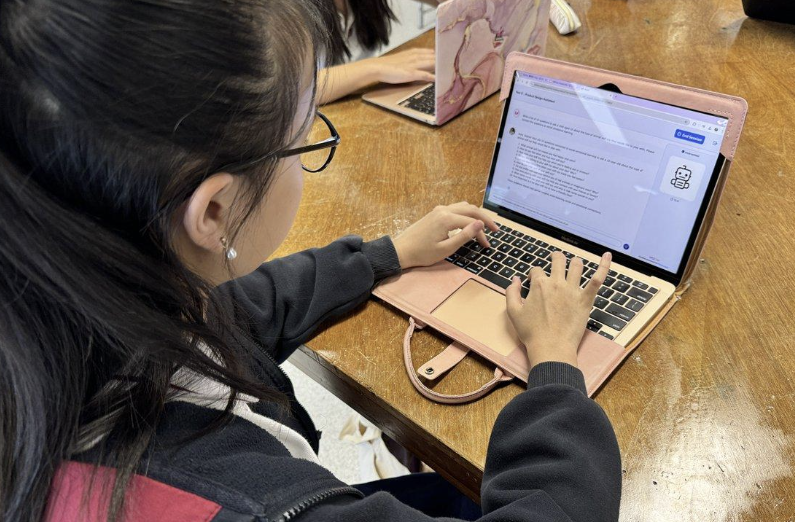
Artificial intelligence, known as AI, has become an important part of our academic lives. From answering questions and explaining difficult concepts to helping students organize ideas and correct their writing or even directly give us answer. AI provides us wiith many new ways to learn. However, while AI can make studying more efficient, it can also create problems when some students depend on it too much. Therefore, AI is influencing students’ academic pursuit in both positive and negative ways.
One major benefit of AI is that it can provide personalized academic support. In a traditional classroom, one teacher may have to help dozens of students at the same time, so it is not always possible to give every student individual attention. AI can provide explanations based on a student’s questions and learning level. For example, if I don’t understand a math problem, AI can explain the process step by step , and even teach me how to do it . This allows us to learn our own pace and review difficult material as many times as necessary.
Another advantage is that AI can us become more efficient. Students often spend a large amount of time searching for information, organizing notes, or checking grammar. AI can help with these tasks and allow students to spend more time thinking critically and developing their own ideas. For students who are learning a second language, AI can also provide useful feedback on vocabulary, grammar, and sentence structure. For instance , just like me , as student who study abroad using my second language , it is really hard for me to fully understand everything my teachers said . So Ai can help me to organize what happened at class, or even give me some extensive information .
However, the growing use of AI also creates academic concerns. The biggest problem is overdependence. If students use AI to complete their homework, write essays, or solve every difficult problem without trying themselves, they may learn less and gradually lose important academic skills. Education is not only about getting the correct answer; it is also about developing problem-solving, creativity, and independent thinking. If AI does all the thinking, students may achieve better results in the short term but become less prepared for future challenges.
In conclusion, AI is changing the way we pursue our academic goals. It can make learning more personalized, efficient, and accessible, but it also requires us to use it responsibly. AI should be viewed as a learning tool rather than a replacement for our own thinking. When students use AI to understand difficult concepts, receive feedback, and explore new ideas while still doing the important thinking themselves, AI can become a powerful tool for academic growth.
R. Cao