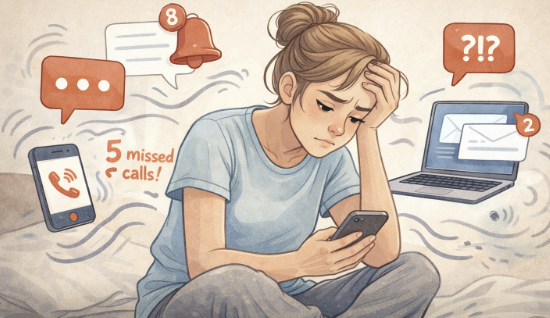
The Price of Being “Always Available”
One of the most normalized social problems of modern life is the expectation that everyone should be constantly reachable. A text message unanswered for two hours can feel like a statement. An email sent at night still carries the silent possibility of an immediate reply. Group chats, direct messages, work platforms, class portals, and social media have created a culture in which availability is treated as a sign of respect, competence, and emotional investment. But the social cost of this expectation is becoming harder to ignore. We are losing the right to be temporarily absent, and with it, a crucial part of what makes life mentally sustainable.
On the surface, constant connectivity seems helpful. It makes coordination easier, allows people to stay in touch across long distances, and gives friends, families, students, and coworkers the ability to communicate quickly. In emergencies, that kind of access can be genuinely valuable. The problem is that emergency-level access has quietly become the everyday standard. Many people now feel pressure to respond not when they are ready, but as soon as they are seen online. Silence is interpreted as avoidance. Delay is interpreted as carelessness. Presence itself has become labor.
This affects relationships in subtle but powerful ways. Instead of communication being based on genuine attention, it often becomes reactive and anxious. People reply while walking, eating, studying, or half-asleep because they fear seeming rude. Conversations are no longer bounded by time or space; they trail into every corner of the day. That can make relationships feel less nourishing and more demanding. Even close friendships begin to carry an undertone of obligation, as if affection must be proven through response speed.
The pressure is especially intense for young people, who often navigate friendships, school demands, and identity formation through digital spaces at the same time. Being “left on read” can feel like public rejection. A late reply can trigger overthinking, insecurity, or conflict that might never have existed in a less immediate communication culture. Instead of technology reducing social stress, it often amplifies it by turning every pause into something interpretable. What used to be normal gaps in conversation now feel emotionally loaded.
Work and school make the problem worse. Students are expected to monitor multiple digital platforms constantly, while workers often carry professional communication into evenings and weekends. The boundary between urgency and convenience has collapsed. Because messages can be sent at any time, they often are. The result is not merely distraction but a deeper erosion of rest. People are physically present in one place while mentally tethered to many others, never fully off-duty.
This culture also changes how we value one another. Availability becomes confused with care. But instant access is not the same as real support. Someone who responds immediately is not always more loving, thoughtful, or responsible than someone who answers later with full attention. In fact, relationships may be healthier when they allow room for slowness, privacy, and uninterrupted life offline. Human beings need mental space in order to think clearly, regulate emotions, and engage meaningfully.
A healthier social norm would recognize that delayed response is not disrespect by default. It is often a sign that a person is living a full human life beyond the screen. We need to rebuild a culture in which being unreachable for a while is not a failure of character. It is a basic condition of freedom.